 Telephone: 1 450-669-9256
 Email: sales@reefsolution.com



Skip to product information
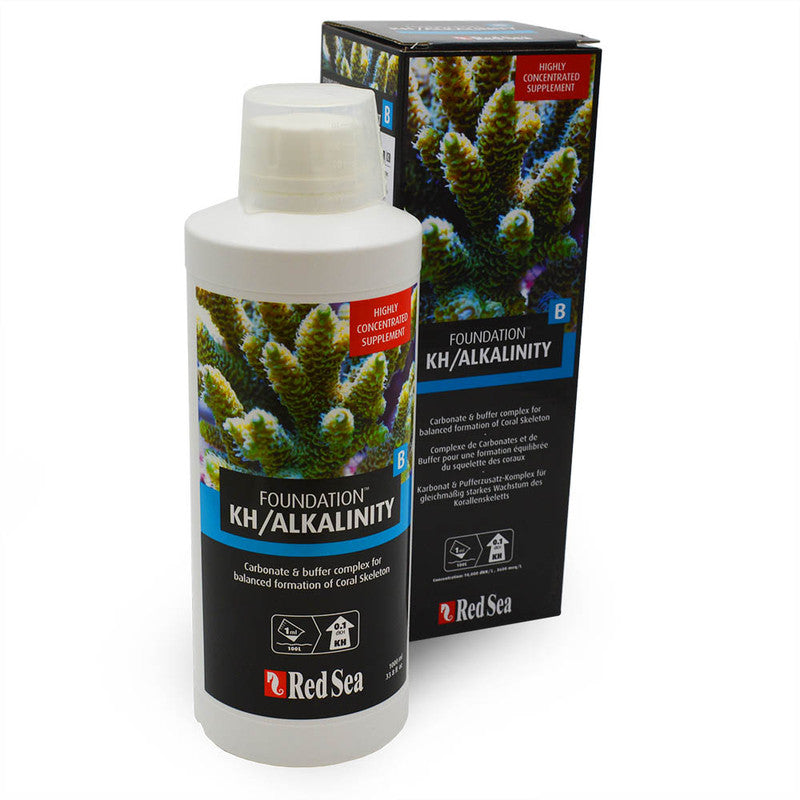


Foundation B KH/Alkalinity 1L — Stable Alkalinity and pH in Reef Tanks - Red Sea
$44.99
Available
Foundation B KH/Alkalinity from Red Sea is a complex of carbonate and other buffers present in seawater. 1 litre liquid bottle — the established-tank size, once you know your daily consumption.
What alkalinity actually measures
Alkalinity is not "the carbonate level". It measures every buffering substance in the water: bicarbonate (HCO₃), carbonate (CO₃), hydroxide (OH) and borate (BO₃). Practical consequence: Red Sea advises avoiding test kits that measure carbonates only, because they throw off every dosing calculation.
Two units coexist: meq/l and dKH. The conversion is dKH = meq/l × 2.8.
Specifications
- Composition: carbonate and other seawater buffers
- Concentration: 1ml raises alkalinity in 100 litres (25 gal) by 0.036 meq/l (0.1 dKH)
- Daily maximum: 0.5 meq/l, or 1.4 dKH per day
- Sizes: 250ml, 500ml, 1L (this listing), 5L and 1kg powder
- Suitable for: SPS, LPS and soft coral reef tanks · dosing pump compatible
⚠️ The powder version is not the same strength: 1g raises alkalinity in 100 litres by 0.12 meq/l (0.33 dKH), and 1kg makes 10L of stock solution. Never carry a calculation from one format to the other.
Target levels for your reef tank
| Aquarium type | Salinity (ppt) | Alk (dKH) | Calcium (mg/l) | Magnesium (mg/l) |
|---|---|---|---|---|
| Mixed reef | 34 | 11.5 | 450 | 1350 |
| SPS dominant | 35 | 8.0 | 430 | 1280 |
| SPS frag tank | 35 | 12.6 | 465 | 1390 |
| ULNS | 33 | 7.0 | 410 | 1220 |
| Marine fish | 30 | 6.8 | 370 | 1100 |
A detail that surprises many: an SPS dominant tank targets LOWER alkalinity (8.0 dKH) than a mixed reef (11.5). When you drop nutrients for colour, lower balanced levels stress the corals less.
How to dose: the manufacturer's method
- Bring Ca, Alk and Mg to their targets.
- Run 4 days without dosing anything, topping up evaporation with fresh water.
- Test, work out the dose to return to target, add it.
- Divide by 4: that is your daily dose for the week.
- Retest weekly and adjust.
Three rules not to skip
- Daily maximums: alkalinity 0.5 meq/l (1.4 dKH), calcium 20ppm, magnesium 10ppm.
- Dosing order: magnesium, then alkalinity, then calcium — 10 minutes between each.
- Where to add it: into the sump, or slowly into a high-flow area.
Reverse trap: adding buffer to a tank whose calcium is already at saturation causes precipitation and drops the calcium.
Which size to choose
The litre suits an established tank dosing daily. To start out or for a nano, the 500ml. For a large volume or a dosing pump running continuously, the 5L costs less per litre.
Goes well with
Alkalinity that will not hold often traces to low magnesium: check with Foundation C Magnesium 1L before raising the buffer. And alkalinity builds nothing without calcium — Foundation A Calcium+ 1L completes the trio.
Frequently asked questions
My alkalinity keeps dropping — why?
Red Sea identifies three common causes: new aragonite substrate, an unbalanced salt mix with low magnesium or high calcium, and excessive calcium dosing without magnesium. Test magnesium first.
How much can I raise alkalinity in one day?
By 0.5 meq/l at most, which is 1.4 dKH. Beyond that, spread it over several days.
Is the 1L the same strength as the 500ml?
Yes: 1ml raises alkalinity in 100 litres by 0.1 dKH in both. Only the powder version differs.
What is the difference between meq/l and dKH?
Two units of the same measurement: dKH = meq/l × 2.8.
Why buy from ReefSolution
Aquarium ReefSolution is an authorized Red Sea dealer. Our team works in marine aquariums in Laval and knows the Reef Care Program from real tanks. We ship across Canada and offer in-store pickup.